
Pheasant Glasses: How to Spot a Hand-Painted Pair Worth Clinking
There are two kinds of pheasant glasses in the world. There's the sort that arrives in a shrink-wrapped set of six, wearing a pheasant the way a bank wears a logo. And there's the sort that somebody actually painted, by hand, with a brush smaller than your little finger, before firing it in a kiln so the bird stays put for good.
Only one of them is worth raising at the end of a day in the field. Here's how to tell them apart, and what to look for before you spend a penny.
Why pheasant glassware is having a moment
Somewhere between the rise of the country kitchen and the general British obsession with birds, pheasant glassware quietly became a thing. Search for pheasant glasses and you'll be met with a wall of options: etched, printed, wrapped, transfer-decorated and, increasingly, hand-painted.
That last category is where the character lives. A pheasant is a magnificent, slightly ridiculous bird - all copper, emerald and attitude - and it deserves better than a decal slapped on a tumbler in a factory. Painted by hand, it gets the tail feathers, the curve of the neck, the glint in the eye. It gets a bit of personality.
What to look for before you buy
Use this as your checklist, whether you're buying from a studio or an antiques fair.
1. Is the paint under a glaze, or just on top?
The single biggest giveaway. Genuine hand-painted glass is decorated with specialist glass enamel and then kiln-fired, so the design is fused to the surface. It doesn't flake off in the dishwasher. It doesn't lift when your thumb rubs the rim after the third toast.
Cheap "hand-decorated" glass often has paint sitting on top of the surface like a sticker, ready to peel the moment it meets hot water. If the seller won't say the word "fired", be suspicious.
2. Does every glass look a bit different?
Real hand-painting has small variations. A feather in a slightly different place. A marginally bolder chestnut on the breast. If you're buying a pair and they're pixel-for-pixel identical, you're looking at a transfer print.
Variation isn't a defect. It's the proof. On a hand-painted piece, tiny differences are the maker's fingerprint.
3. Can you see brushwork?
Get close. Look for the way the paint sits - the soft edge where two colours meet, the odd deliberate flick of a brush. Machine decoration is flat, uniform and weirdly soulless up close. Hand-painting looks alive.
4. Is it signed?
A maker who's proud of the work will usually sign it. At Jack Fethers every piece is hand-painted, kiln-fired and signed in the studio, which is a quiet way of saying: yes, a person made this, and yes, they'd like you to know it.
5. Does the shape suit the drink?
A pheasant on a glass is lovely. A pheasant on the right glass is better. Think about what's going in it before you fall for the artwork.
Wine, gin or tumbler: which pheasant glass is yours?
Pheasant glassware comes in three shapes worth knowing, and they do genuinely different jobs.
Wine. The long, generous bowl gives a hand-painted pheasant room to stretch its tail feathers. Best for reds, and for the sort of dinner where nobody's in a hurry.
Gin. A smaller canvas, which makes the painting effort more impressive - the bird has to be composed tightly, but it still has to read clearly through a busy glass. A proper country G&T glass.
Tumbler. The workhorse. Whisky, water, a bit of ice, no ceremony. Pairs beautifully with a Game Bird Glencairn Whisky Glass if you're building a set for the drinks cabinet.
Buying the lot? The Pheasant Glasses range covers all three shapes, hand-painted and fired, so you can mix and match to taste.
Hand-painted vs vintage: an honest comparison
Search "vintage pheasant glassware" and you'll land in beautiful, expensive territory - 1stDibs, auction houses, antique dealers. Vintage pheasant glasses have real charm, and a bit of history you can't manufacture.
But be clear-eyed about what you're buying:
- Vintage is one-of-a-kind, but it's also fragile, often sold singly, and hard to replace if one chips. Prices climb fast for good pieces.
- Hand-painted new gives you the same handmade character with a maker you can talk to, a replaceable set, and the knowledge that it was painted this year by a living pair of hands.
If you want an antique, chase the antique. If you want the look and feel of hand-painted pheasant glass without the auction-house anxiety, a studio piece is the smarter buy - and often the better value.
Pheasant glasses as a gift
This is where pheasant glassware earns its keep. It's the rare gift that works for almost anyone with a foot in the countryside: the whisky drinker, the shooting party host, the friend whose kitchen has a dog bed in the corner and a Land Rover key on the hook.
A hand-painted pheasant glass says "I thought about this" in a way a gift card never will. And because each one is individually painted, you're not handing over the same thing everyone else bought.
Pair a glass or two with a signed British bird print and you've got a gift with genuine weight - something that lives on a shelf long after the wrapping paper's gone.
The Jack Fethers pick
If you want the short version: our hand-painted pheasant glasses in wine, gin and tumbler shapes are painted by hand, kiln-fired so the bird stays put, and signed in the studio. No two are exactly alike, which is entirely the point.
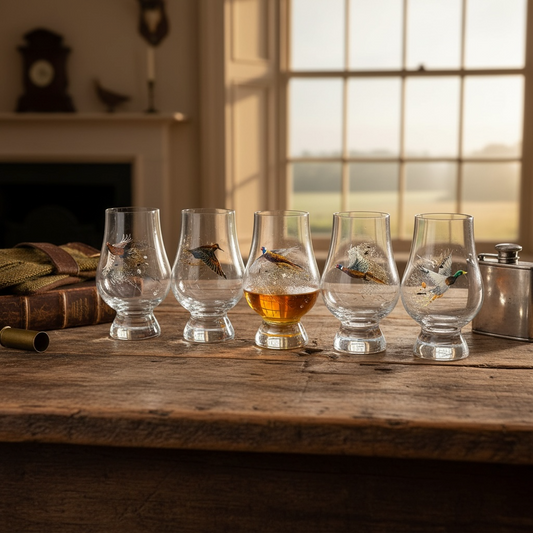
For the whisky drinker in your life, the hand-painted Game Bird Glencairn Whisky Glasses are the connoisseur's choice - the right shape for a proper dram, with a game bird painted on it.
And if you'd rather your pheasant hung on the wall than sat on the table, there's always the Colourful Pheasant Art Print, framed or unframed.
The bottom line
A good pheasant glass isn't the cheapest one on the shelf. It's the one where you can see the brushwork, feel the difference between one glass and the next, and know that the paint isn't going anywhere. Buy hand-painted, buy fired, and - if you can - buy from someone whose name is on the bottom.
Everything else is just a bird on a beaker.