
Table of Contents
- Why Custom British Wildlife Art Stands Apart
- The Value of Original Wildlife Art vs. Mass-Produced Prints
- How to Choose Wildlife Art for Home Decor
- Commissioning Wildlife Paintings: What to Expect
- Featured British Wildlife Art: Signed Prints and Framed Originals
- How to Buy Custom British Wildlife Art Online With Confidence
- Caring for Your Wildlife Artwork at Home
- Conclusion
Last Updated: August 22, 2026
Why Custom British Wildlife Art Stands Apart
Custom British wildlife art is a category that refuses to sit quietly on a wall. It carries a story, the specific morning a pheasant broke from the hedgerow, the particular stillness of a woodcock in winter cover, and that narrative quality is precisely what separates it from the decorative prints filling every high-street homeware shop.
At Jack Fethers, the work begins with a genuine relationship between artist and subject. Jack Fetherstonhaugh has been painting professionally since 2012, and that depth of practice shows in the way light catches a feather, the way a bird's posture reads as alive rather than illustrated. When you commission or buy a signed print from this studio, you are not selecting from a catalogue of generic countryside imagery. You are choosing a piece of art that emerged from direct observation and real craft.
The broader market for buying custom British wildlife art online has grown considerably as collectors and gift-givers look beyond mass retail. Many people find that a framed original or a limited signed print carries a weight of meaning that no mass-produced alternative can replicate. The subject matter matters too: British species, pheasants, woodcock, partridge, resonate because they are genuinely part of the landscape people love, not exotic imports chosen for visual novelty.
What most guides to buying art online miss is this: the question is not simply "what looks good?" It is "what will still feel meaningful in ten years?" That is the standard worth applying here.
The Value of Original Wildlife Art vs. Mass-Produced Prints
Most people underestimate how quickly a mass-produced print reveals itself. The ink sits on the surface differently. The paper lacks weight. Nothing about it suggests a human hand was ever involved.
The value of original wildlife art is not purely aesthetic, it is also relational. An original or a limited signed print comes with provenance: a specific artist, a specific edition number, a pencil signature that confirms this object exists in a finite quantity. That scarcity is not manufactured; it is a natural consequence of how art is made.
What You Actually Get With a Signed Original
A signed original, or a signed limited edition print, gives the buyer several things a poster cannot:
- Authenticity: the artist's signature in pencil confirms the piece is genuine, not a reproduction run in the thousands
- Finite edition: limited print runs mean the work holds its character as something special rather than ubiquitous
- Collectibility: works by established artists with a consistent body of work tend to hold or increase in interest over time
- Giftability: a signed, framed piece arrives as a complete, considered gift rather than something that requires additional effort from the recipient
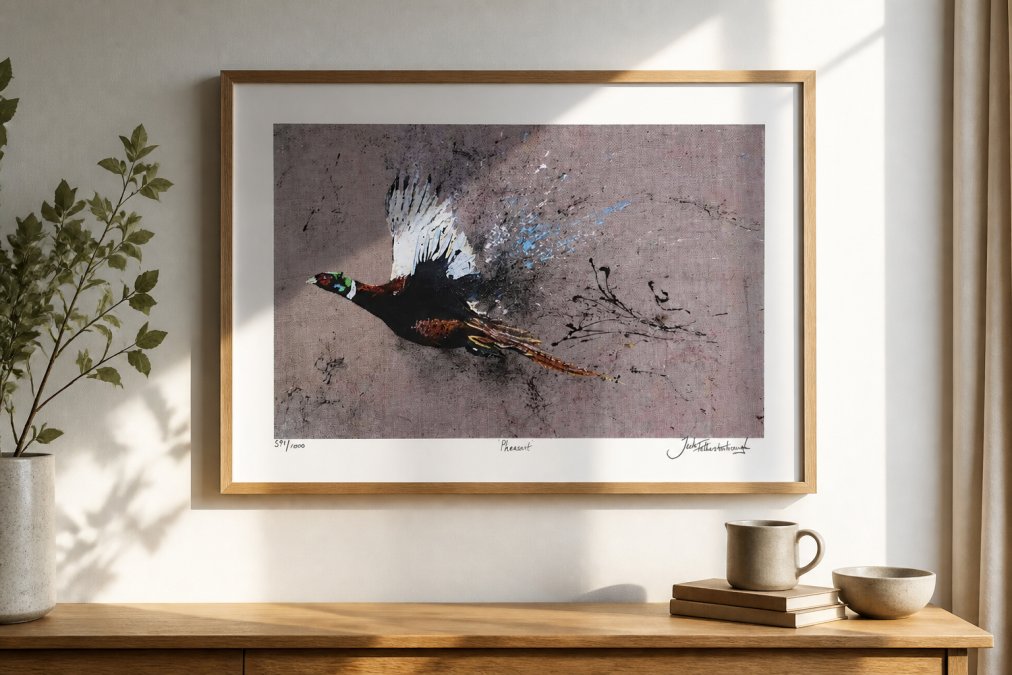
Jack Fethers' Framed Pheasant in Flight illustrates this well. Numbered, framed, and signed by the artist, it arrives ready to hang at £64.99, a price point that puts a genuinely original artwork within reach without requiring a gallery budget. The Woodcock & Partridge prints, available from A4 to A1 and signed and titled by Jack, offer a similar proposition at £19.99.

According to Arts Council England's guidance on collecting original art, buying directly from artists and their studios is one of the most reliable ways to ensure authenticity and support working practitioners.
How to Choose Wildlife Art for Home Decor
Choosing wildlife art for home decor is less about matching colours to cushions and more about choosing the right weight of presence for a room.
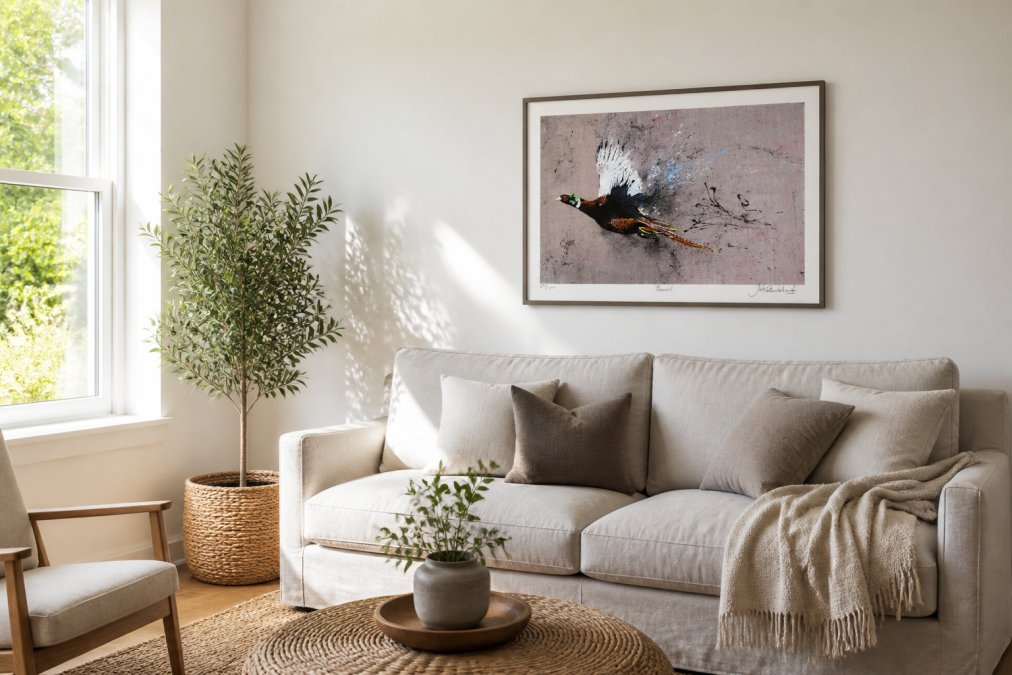
A common mistake is assuming that wildlife art only suits traditional interiors, flagstone kitchens, dark wood furniture, hunting lodge aesthetics. The reality is almost the opposite. A bold, colourful pheasant print in a slim contemporary frame sits beautifully against a neutral plaster wall in a modern flat. The key is contrast: wildlife art brings organic irregularity into spaces that might otherwise feel too clean or corporate.

Matching Wildlife Art to Contemporary and Traditional Interiors
The framing choice does most of the work here. The same print can read as country-house traditional in a wide gilt frame or quietly modern in a slim black or natural oak frame. Before ordering, think about:
- Wall colour: warm-toned art (ochres, umbers, the russet of a pheasant's plumage) works well against off-whites, greys, and greens
- Room scale: A3 and A4 prints suit smaller rooms, hallways, and grouped arrangements; A1 and A2 prints command a focal wall
- Interior style: for contemporary spaces, choose prints with strong graphic composition and limit the frame profile; for traditional rooms, a wider mount and deeper frame adds formality
The Colourful Pheasant Print, originally painted on hessian using acrylic, is a particularly versatile piece. Its warmth and movement work in both a country kitchen and a modern living room, which is why it has become a bestseller. Available in A3 and A4 at £19.99, it is an accessible starting point for anyone new to buying British wildlife art.
The thing nobody tells you about choosing art for your home is that you should trust the piece that makes you stop, rather than the one that matches most efficiently. Matching is a starting point, not the destination.
Commissioning Wildlife Paintings: What to Expect
Commissioning wildlife paintings is a different experience from buying a ready-made print, and it is worth understanding the process before you commit.
The starting point for any commission is a clear brief: what species, what mood, what size, and what the piece is for. A retirement gift for a keen game shooter requires a different approach than a wedding present for a couple who spend weekends birdwatching. The more specific you can be at the outset, the better the outcome.
Timelines, Revisions and What to Ask Before You Order
The most common question before commissioning is about timing. For a wedding in three months, a commission is realistic provided you contact the artist early and confirm the timeline explicitly. Most wildlife commissions involve an initial sketch or concept stage, followed by the finished work. Revisions are typically possible at the sketch stage; changes after the final piece is complete are more limited, which is why the brief matters so much upfront.
Before placing a custom order, ask the following:
- What is the estimated delivery timeline from brief to completion?
- At what stage can revisions be requested, and how many rounds are included?
- What format will the finished piece be delivered in, original canvas, framed print, or unframed?
- What happens if the finished piece does not meet expectations?
These are not awkward questions. Any professional artist working to commission should answer them without hesitation. Clarity at the beginning protects both parties and almost always produces a better piece.
According to the Consumer Rights Act 2015 guidance on bespoke goods, custom-made items are treated differently under consumer law than standard goods, so understanding what is agreed upfront is especially important for commissioned work.
Featured British Wildlife Art: Signed Prints and Framed Originals
The Jack Fethers collection covers a range of formats and price points, making it accessible whether you are buying a first piece of wildlife art or adding to an existing collection.
Here is a summary of the current range to help you choose:
| Piece | Format | Price | Best For |
|---|---|---|---|
| Original Pheasant Prints | A4 & A3, signed | £14.99 | First purchase, affordable gift |
| Colourful Pheasant Prints | A4 & A3, signed | £19.99 | Contemporary interiors, bold colour |
| Woodcock & Partridge | A4 to A1, signed | £19.99 | Game bird enthusiasts, larger walls |
| Framed Pheasant in Flight | Framed, numbered, signed | £64.99 | Statement gift, ready to hang |
The Original Pheasant Prints at £14.99 are the most accessible entry point, signed and titled in pencil, limited in number, and genuinely collectable despite the price. For buyers who want something more substantial, the Framed Pheasant in Flight arrives as a complete, gallery-ready piece.

Custom commissions sit outside this ready-made range. If the species or composition you want is not represented in the current collection, a commission allows you to work directly with Jack to create something specific.
How to Buy Custom British Wildlife Art Online With Confidence
Buying custom British wildlife art online carries a specific set of concerns that buying in a gallery does not. You cannot hold the piece, assess the paper weight, or see the signature in person before committing.
The most reliable way to buy with confidence is to look for evidence of consistent practice over time. Jack Fethers has been operating as a professional artist since 2012, that longevity is itself a signal. A studio that has been producing and selling original work for over a decade is not a side project; it is a working practice with a track record.
Practical steps for buying confidently online:
- Review existing work thoroughly: look at multiple pieces across different species and formats to assess consistency of quality
- Check the edition details: signed and numbered prints should state the edition size clearly, "limited" without a number is a weaker claim
- Understand the delivery and returns terms: for standard (non-custom) prints, the Consumer Rights Act 2015 gives you the right to return goods that are not as described
- Ask questions before ordering: a responsive artist or studio is a good sign; slow or evasive responses before a purchase tend to predict the experience after one
For custom commissions specifically, the process of asking detailed questions before ordering is not just due diligence, it is how you begin the creative conversation that produces the best result.
As Which?'s guide to buying art online notes, buying from an established artist with a verifiable history and clear terms gives buyers significantly more protection and confidence than purchasing through anonymous marketplace listings.
Caring for Your Wildlife Artwork at Home
Original prints and framed originals are more resilient than many buyers expect, but a few straightforward habits will keep them looking exactly as they arrived.
Light exposure is the primary concern. Direct sunlight will fade pigment over time, regardless of paper or ink quality. Hang prints away from windows that receive direct afternoon sun, or use UV-filtering glass if the location is unavoidable. North-facing walls are ideal.
Humidity and temperature matter more than most people realise. Rooms with significant temperature swings, conservatories, rooms above radiators, create conditions where paper expands and contracts, eventually causing waviness or foxing. A stable, moderately heated room is the best environment.
For framed pieces, the frame itself does most of the protective work. Check that the mount and backing are acid-free; over decades, acidic materials discolour the paper they touch. Reputable framing uses conservation-grade materials as standard.
If a print arrives unframed, store it flat or rolled in acid-free tissue rather than folded. Fold lines in paper are permanent.
For general guidance on preserving works on paper, the Victoria and Albert Museum's conservation advice for collectors offers clear, practical recommendations that apply to prints and limited edition works at any price point.
A well-cared-for signed print will look as good in twenty years as it does today. That is part of what makes buying original wildlife art a different proposition from buying a poster.
Choosing and buying wildlife art involves more than finding something that looks right. The question of whether a piece will hold its meaning, as a gift, as a presence in a room, as an object someone will still value in a decade, depends on the quality of the work and the seriousness of the artist behind it. Jack Fethers offers a curated collection of signed prints and framed originals, alongside custom commission options, that address exactly that question. Browse the full range and find a piece that fits your space, your occasion, or the person you have in mind.
Frequently Asked Questions
How do I commission a custom wildlife painting from Jack Fethers?
Commissioning British wildlife art through Jack Fethers starts with getting in touch to describe the subject, size, and any occasion you have in mind. Jack Fetherstonhaugh, a professional artist since 2012, will discuss your brief, confirm a timeline, and keep you updated throughout the process. For events such as weddings or retirements, it is always worth contacting the studio early to confirm availability and avoid any last-minute pressure.
What factors determine the value of original wildlife art?
The value of original wildlife art rests on several things: the artist's track record and professional standing, whether the piece is a one-of-a-kind original or a numbered limited edition, the quality of materials used, and the subject matter's enduring appeal. Signed and numbered prints hold more value than open editions because scarcity is built in from the outset. Provenance also matters, knowing who created the work, when, and under what circumstances adds meaning that mass-produced alternatives simply cannot replicate.
Are signed limited edition prints a good investment?
Signed limited edition prints occupy the space between affordable and collectable. Because each print in a limited run is numbered and hand-signed in pencil by the artist, the edition cannot be expanded later. Over time, as an artist's reputation grows and the edition sells out, remaining prints become harder to source. They are not a guaranteed financial investment, but they do hold sentimental and cultural value that open-edition reproductions lack, making them a considered purchase rather than a speculative one.
Will British wildlife art suit a modern, contemporary interior?
British wildlife art works well in contemporary spaces when the composition and palette are chosen thoughtfully. Bold, graphic treatments of birds such as pheasants or woodcock, particularly pieces originally painted on textured surfaces like hessian and reproduced with vivid acrylic colour, sit comfortably alongside clean lines and neutral walls. The key is framing: a slim, understated frame in dark wood or brushed metal keeps the piece feeling current rather than traditional. Subject and style matter more than the wildlife theme itself.
This article was written using GrandRanker